
Questionnaire 7: Virginia Gris

Updated: 7 days ago

Name:
Virginia Gris (she/her)
What was your experience navigating academia? What factors impacted your journey?
I entered the world of academia extremely sure of my wanting to pursue a career in the arts but knowing very, very little of how to go about doing so. Back in the Dominican Republic, my parents—along with most of the generation before me—had gone to college despite struggling a lot financially; but they had all chosen pretty conventional careers (medicine, law, architecture) so they were just as confused as I was when it came to figuring out how I could approach this. The only thing that was clear to me about the whole process was that I needed to leave the country if I wanted to get official academic training since, back then, none of the universities in the DR had an art-related program. In hindsight, I do see why my parents were initially opposed to my decision. If I had stayed in the DR and gone for a more traditional career, I would have had a more uneventful, more linear path to success. Instead, I chose to become an immigrant to the US and to start jumping through the endless hoops that come with being a foreigner here.
I chose to get a degree in theatre. I can’t emphasize enough how oblivious I was to the importance of choosing the right school, or even to what an application process would entail. In the DR, one would go to the school one could afford to pay; no one was waiting for an acceptance letter, no one was preparing a portfolio or coming up with interesting things to say in an application letter. Honestly, my guides were random people on blogs and threads on the internet. I accepted the first offer I received right away, fearing that I wouldn’t get any others.
Many years later, when I decided to apply for an MFA, this experience in American academia came in handy, of course. For example, the application process wasn’t a surprise this time around. But, since I was veering towards Creative Writing, it did feel like starting from scratch: figuring out schools, understanding what each of them was looking for, seeing if and how I could make both degrees work with one another to sort of craft a path towards the career in the arts that I wanted.
What advice do you have? What do you wish you knew?
Like many Latin American people, I had learned English at school when I was a child so language per se wasn’t a barrier, but there were some cultural aspects that made it challenging for me to keep up with my peers. For instance, sometimes a professor would make a joke and I wouldn’t get it immediately because I wasn’t familiar with some of the slang. Things like these made it so much harder for me to become a part of any kind of “inner circle”. Feeling like a foreigner has this way of limiting your social skills. On top of everything, the fact that I was proficient in English and didn’t have a very heavy accent made a lot of people forget that I was a recent immigrant and so they assumed I was simply bored with the class or that I was just weird for not reacting right away—when in reality I was probably translating in my head, or trying to figure out an idiom.
So, I wish I had known that—especially during my undergrad—the faculty wasn’t going to take into consideration my reality as an immigrant, or the fact that the steps towards a smooth academic life in the US had not been explained to me. I feel that, for at least the first year, I kept waiting for help to arrive. I wish I could tell my younger self to realize sooner that it’d be on her to figure out those steps she was missing, or to find a way to make up for the disadvantages of trying to get an education in a country she had yet to fully understand.
Has being a first-gen student or a student with cultural class boundaries led to any
advantages to your journey and/or your art?
Definitely. That initial stage of cultural adaptation that I went through as a young adult eventually gave way to a kind of idiosyncratic culture that I know has become the most important part of my work, both in film and in poetry. It took me a while to recognize this particular mixture of cultures as my creative cornucopia but, now that I’m able to see it all from a kind of distance, I realize that multiculturalism was never not a part of who I was. My readiness to become a migrant because of academia was exactly the kind of clarity of thought that I had inherited from my family. My great-grandparents and grandparents, after all, had all chosen to migrate (some within the DR, some from Spain, some from Palestine) to find a place that better suited their needs. Of course, their needs were of the basic and urgent kind, whereas mine were intellectual, but I do see it as a natural continuation of the story. And that story can be found, in one way or another, all over my writing. I feel that those parts of myself wouldn’t have been so clear to me had I stayed in the DR. There, being multiethnic/multicultural isn’t particularly extraordinary but in the US, where cultures very seldom mix, I was forced to examine how the whole of my family’s history had affected who I was.
In terms of my own journey, well, the cultural boundaries have not really worked as an advantage, but they have helped me find community. Not only within the first-gen and immigrant artists crowd but within every community of artists who has had to work around the established set of rules that still dictates one's path in academia.
Can you share an anecdote of a time when you especially felt your background impacted
your experience in academia?
The theatre program I chose luckily ended up being the right place for me but, as I was coursing it, I didn’t know that I had to do more than just go to classes and graduate if I wanted to become a better artist. I think I understood intuitively that, even in an academic setting, training in the arts wasn’t supposed to be a rigid, check marked path but I still had to unlearn so many deep-rooted ideas about what becoming a professional meant.
While growing up, I’d heard so many times the story of how my parents and their siblings had to overcome so much precariousness just to graduate, that somehow it became engrained in me that the most pressing goal was to get that degree. So, when a professor suggested I could benefit from taking a semester off and enrolling in a conservatory that taught a different approach to theatre, I immediately said no, foolishly thinking that graduating even half a year past the date I had initially planned for would be a failure. It was just such a big disappointment, not only for my family but for most people in the DR, that someone would extend their time at school, or decide to switch their major midway through their studies, or do anything unexpected, really. People who did that were considered lazy and unreliable, without a clear purpose in life. I always prided myself on not being as narrow-minded as to share those views but there I was, fixed on graduating in time instead of seeing the bigger picture.
Now that I’m almost finishing my MFA, I still struggle to have a clear idea of everything that I should be doing to take advantage of the program—to not just be there to learn but to make my academic life work in favor of my creative life—but I’m more conscious of the relationships I make with the faculty and with my peers, and I’m comfortable taking my time, focusing on exploring the ways in which my work wants to move rather than on reaching a graduation deadline that would make said work “legitimate”. Still, though, there’s a little voice always warning me that there might be stuff that I should be doing but am not; things that someone who has grown up in the US or who has an undergrad in Creative Writing, and not in Theatre, would already know about. No matter how much time has passed since I moved to the US or how far along my career has gone, that anxiety of not having all the information I should have, remains.
How would you like to see creative writing culture change?
I’m particularly fascinated by the never-ending conversation around the role of academia in creative writing. We all need that structure and depuration of skill which it certainly offers but we also want that idyllic, “raw” creativity—unsullied by generations and generations of intellectualized taste. Don’t get me wrong, I’m definitely on the side of the MFA but I do sometimes wonder whether we really are able to separate the work from the pedigree. I don’t remember the last time I read a book by a new artist without having their academic background shouted at me first. I try to put myself in the place of a civilian and wonder if they’d actually need that info, or even care about it. I don’t think so. I think we do it for ourselves. A kind of reassurance, a “Look, this writer’s one of us!” sort of thing which I guess makes sense, but it’s still interesting and a bit worrying.
Your own publications or projects you'd like to share
Currently working on my chapbook, After the barbecue, and my new feature film, Song of the Father.
Other writers/artists you'd like to highlight
I’ve been re-reading J. Estanislao Lopez’s We Borrowed Gentleness. It’s fantastic, I’m always discovering some new great line in it. I’m also a big fan of Bebe Ashley’s exploration of visual poetry within the structure of braille—multidisciplinary work really interests me. Her collection Harbour Doubts is fantastic.
Bio
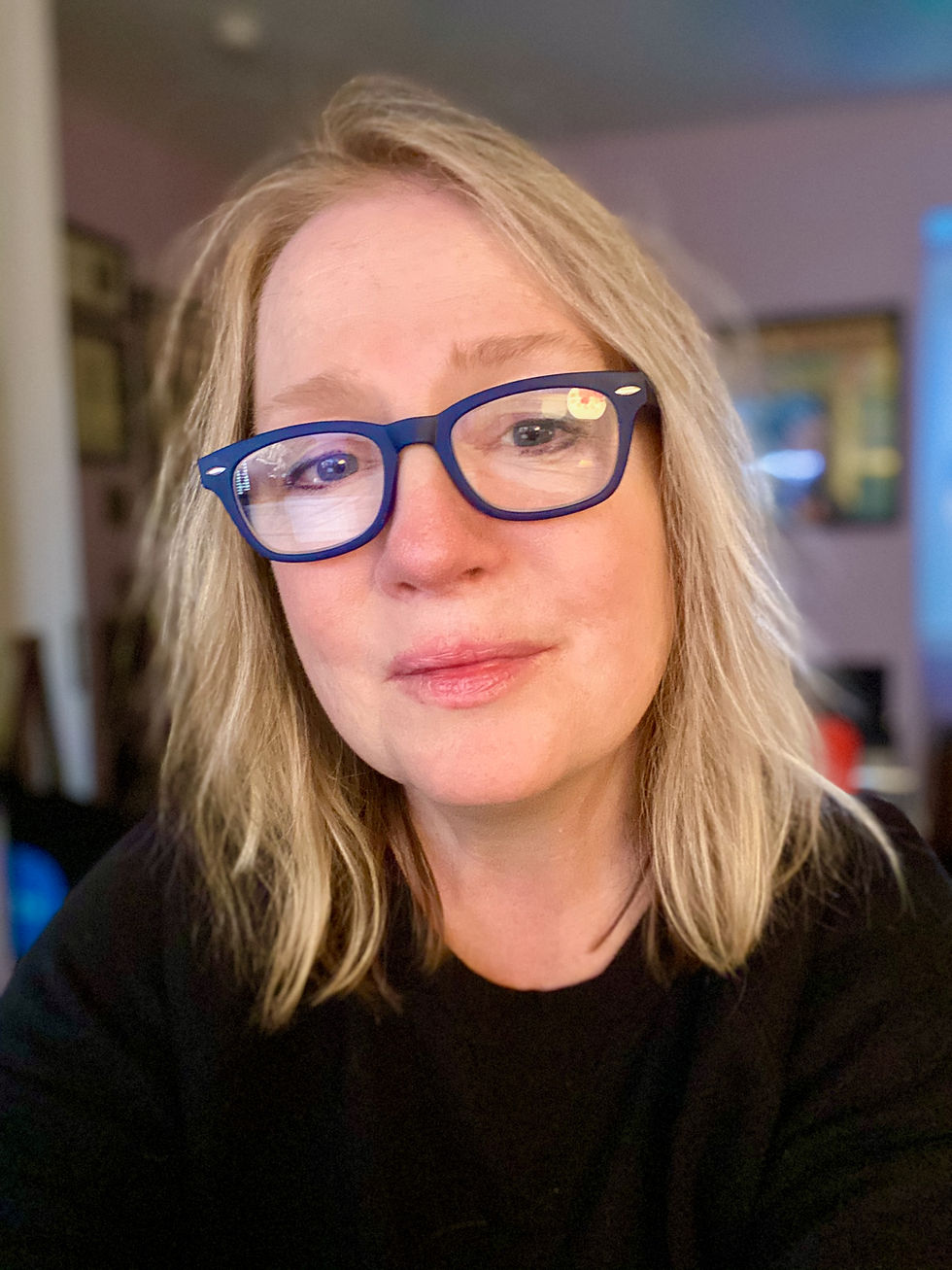
Virginia Gris is a Brooklyn-based multidisciplinary artist with a background in poetry, theatre, and film. She was born in the Dominican Republic to a family of mixed heritage—immigrants from Asturias, immigrants from Palestine, as well as native Dominicans. Now an immigrant herself, in the United States, this amalgam of cultures and nationalities has become a significant theme in her creative work—a constant search for a definite identity and home.
Gris’s film work has been part of the lineup at several international venues such as the Austin Film Festival, Cinequest, Chelsea Film Festival, Festival Mix Mexico, and the Philadelphia Latino Film Festival. Her poetry has been accepted for publication in Women's Studies Quarterly, Promethean, The Marbled Sigh, and in several Hispanic publications. She is currently completing the Creative Writing MFA at The City College of New York.

Comments